

Commons:Village pump/Copyright
This Wikimedia Commons page is used for general discussions relating to copyright and license issues, and for discussions relating to specific files' copyright issues. Discussions relating to specific copyright policies should take place on the talk page of the policy, but may be advertised here. Recent sections with no replies for 7 days and sections tagged with {{section resolved|1=~~~~}} may be archived; for old discussions, see the archives.
- One of Wikimedia Commons' basic principles is: "Only free content is allowed." Please do not ask why unfree material is not allowed at Wikimedia Commons or suggest that allowing it would be a good thing.
- Have you read the FAQ?
- Any answers you receive here are not legal advice and the responder cannot be held liable for them. If you have legal questions, we can try to help but our answers cannot replace those of a qualified professional (i.e. a lawyer).
- Your question will be answered here; please check back regularly. Please do not leave your email address or other contact information, as this page is widely visible across the Internet and you are liable to receive spam.
- Please do not make deletion requests here – instead, use the relevant process for it.
 |
SpBot archives all sections tagged with {{Section resolved|1=~~~~}} after 1 day and sections whose most recent comment is older than 7 days. |
Is this template valid? Apparently used to tag images of works of art from Taiwan in which their designers or artists "waived" their rights to claim copyright if the photos of their works are commercially used (?). No image uses this template as of this writing. See recent changes at COM:FOP Taiwan. JWilz12345 (Talk|Contributions) 02:10, 22 December 2025 (UTC)
- At the very least, this should be renamed as {{Copyrighted free use-Taiwan-art}}, on the same pattern as {{Copyrighted free use}}. Technically this is not a Freedom of Panorama exemption, since FoP is only a legal privilege given by law. The waiver from the artists constitutes the precepts of the CopyrightedFreeUse template, not the FoP law of Taiwan (no disclaimer provided under Article 58). Ping @Teetrition: (who was one of the involved users in Taiwanese FoP discussions). JWilz12345 (Talk|Contributions) 02:17, 22 December 2025 (UTC)
- I agree with you. I've noted the changes at COM:FOP Taiwan, and it seems doubtful that any artists would actually use this disclaimer. Teetrition (talk) 02:53, 23 December 2025 (UTC)
- @Teetrition I may boldly move the template title by myself, to {{Copyrighted free use-Taiwan-art}}, if no one opposes. "BUMPING" this again to prevent bot archiving. JWilz12345 (Talk|Contributions) 04:14, 28 December 2025 (UTC)
 Support move, so the name will more clearly reflect the template's content and purpose. Thanks. Tvpuppy (talk) 16:24, 1 January 2026 (UTC)
- @Teetrition I may boldly move the template title by myself, to {{Copyrighted free use-Taiwan-art}}, if no one opposes. "BUMPING" this again to prevent bot archiving. JWilz12345 (Talk|Contributions) 04:14, 28 December 2025 (UTC)
- I agree with you. I've noted the changes at COM:FOP Taiwan, and it seems doubtful that any artists would actually use this disclaimer. Teetrition (talk) 02:53, 23 December 2025 (UTC)
 Info I restored this from archives. I believe there is not yet enough consensus. "BUMPING" to reset archive countdown. JWilz12345 (Talk|Contributions) 03:52, 9 January 2026 (UTC)
US Passport photos
[edit]On the page for Category:United States passport photos there is a section about the copyright of passport photos. It raises the possibility that passport photos may not be eligible for copyright because they do not meet the threshold of originality. That seems to rely only on a statement found on this page. It is not at all clear that the statement was made in relation to US passports.
I believe that passport photos meet the deliberately low bar for originality despite the guidelines that photographers must follow. Regardless of my opinion, we should clearly be following the precautionary principle here. If we are not certain that US passport photos are ineligible for copyright, we should not have them here.
I don't believe that the discussion of copyright on the category page is normal or helpful. Any such statements belong in guidelines or help pages. I have read the recent discussions on this noticeboard and I learned nothing. Is there any settled case law about this? Is the entire "below the threshold of originality" just some editor's wishful thinking or is there a documented basis for it? Counterfeit Purses (talk) 05:20, 23 December 2025 (UTC)
- My only problem with accepting passport photos is we reject other photos that are below TOO, There was a New York case that ruled thay clip art such as photos of food on a menu were below TOO but good luck gettinh Commons to accept them. -Nard (Hablemonos) (Let's talk) 12:42, 23 December 2025 (UTC)
- @Nard the Bard I would be surprised by that ruling. What is the name of the case? Counterfeit Purses (talk) 16:41, 23 December 2025 (UTC)
- Oriental Art Printing, Inc. v. Goldstar Printing Corp.; one of the photographs denied protection by that case is found on page 1522 of this Brooklyn Law Review article. prospectprospekt (talk) 17:55, 23 December 2025 (UTC) edited 18:02, 23 December 2025 (UTC)
- @Nard the Bard I would be surprised by that ruling. What is the name of the case? Counterfeit Purses (talk) 16:41, 23 December 2025 (UTC)
- Per the US State Dept.'s website, it is clear that individuals outside the US govt may create and submit their own passport photos according to particular guidelines, so we cannot rely on arguments utilizing {{PD-USGov-DOS}}.
- (Disclosure: I am not a lawyer, I am an amateur only attempting to make sense of what I have read.)
- The only relevant case I can find with such routine portrait photography is the California case Dlugolecki v. Poppel, which dealt with unauthorized usage of yearbook photos of Meghan Markle in news broadcasts.
- In its summary of the same preliminary finding, the US Copyright Office said "On [...] the nature of the copyrighted work, the court declined to “make any fine distinctions between creative and factual works,” accepting that there was a minimal measure of creativity in the photographs that slightly benefited Dlugolecki."
- According to a 2025 article by law professor Paul Szynol, "A mug shot and passport photos are paradigm examples of an image produced in strict compliance with preexisting dictates that, by definition, not only don’t require creativity, but actively prohibit it. [...] Generic portraits—like high-school yearbook photos—are no more creative than mug shots." I am not sure if Dlugolecki v. Poppel went beyond a preliminary finding, or if its ongoing, but if it did ultimately conclude that such photographs were not protected by copyright, that would most likely mean that passport photos wouldn't be either.
- Since I am not a lawyer, I therefore have to ask these questions:
- Is Dlugolecki v. Poppel ongoing? Did the case conclude beyond anything other than a preliminary finding?
- If so, would its verdict about the yearbook photos say anything about the copyrightability of passport photos?
- If not, is its preliminary finding enough for "significant doubt" about such photos' copyrightability that COM:PCP will require us to delete passport photos?
- – Howardcorn33 (💬) 13:09, 23 December 2025 (UTC)
- @Howardcorn33 I think you may have misinterpreted the statement in Dlugolecki v. Poppel. They were merely stating that despite the nature of the images, they met the standard for creativity. It wasn't in doubt. That statement is just checking off an item on the checklist.
- Szynol isn't saying that passport photos and mugshots are ineligible for copyright. He is saying that they shouldn't be, which is very different. Right after the sentence that you quote, he says
The formulae listed above would nevertheless provide courts with a doctrinal basis for finding creativity
and lists the reasons. He is saying that mugshots and passports photos are, in the current interpretation of the law, copyrighted. Counterfeit Purses (talk) 16:39, 23 December 2025 (UTC)- @Counterfeit Purses: thanks for clarifying. So should we take Szynol's statement about the current interpretation of the law (rather than his own advice) to mean that such photos are indeed copyrighted and therefore we should not permit them on Commons? – Howardcorn33 (💬) 19:35, 23 December 2025 (UTC)
- (Or at the very least that such photos have such significant doubt regarding their copyright status that COM:PCP applies?) – Howardcorn33 (💬) 19:36, 23 December 2025 (UTC)
- @Howardcorn33 That's how I take it but I'm just another editor like you and not an expert in these matters. Counterfeit Purses (talk) 22:27, 23 December 2025 (UTC)
- Has there ever actually been a case in the United States of anyone successfully registering copyright of a mugshot photo? Do we have any legal precedent here? PARAKANYAA (talk) 06:06, 26 December 2025 (UTC)
- @Counterfeit Purses: thanks for clarifying. So should we take Szynol's statement about the current interpretation of the law (rather than his own advice) to mean that such photos are indeed copyrighted and therefore we should not permit them on Commons? – Howardcorn33 (💬) 19:35, 23 December 2025 (UTC)
- Szynol isn't saying that passport photos and mugshots are ineligible for copyright. He is saying that they shouldn't be, which is very different. Right after the sentence that you quote, he says
- For me, almost any photo of a 3D object has enough creativity to merit a copyright. Even if I'm wrong, the issue is close enough to raise COM:PCP.
- The arguments for mugshot and passport photos usually play in another sandbox.
- The mugshot question is usually about whether photographs taken by government employees have a copyright. That question varies by jurisdiction. Criminals do not supply their own mugshots.
- Passport photos are not taken by government employees. Is my passport photo a work for hire where I own the copyright or does the photographer still hold the copyright? There usually is not a written contract where the copyright is transferred to me. A similar situation is when a passerby snaps a photo of me using my camera. Ramanujan's passport photo is a complicated mess: an unknown Indian photographer took the photo, but Chandrasekhar's heir claims she got the rights from Ramanujan's heir.
- Back to creativity. I like my current driver's license photo. I was told to stand on the mark; that does not require much creativity. The DMV employee then gave me two posing instructions — instructions not needed for the ID photo. For me, those instructions take the picture out of the carnival photo booth realm. Even without those instructions, a yearbook or passport photographer gets to set up the lighting, and that involves more than mechanically clicking a shutter release. Maybe the same spacing and lighting is used for hundreds of passport photos, but that does not mean no creativity was involved. A Kodak pamphlet goes into a lot of detail about setting up lighting for a portrait.
- The Copyright Office has also registered CCTV footage, so there is a presumption that even some utilitarian imaging can have a copyright. There are utilitarian images that are outside of copyright. For example, my recent series of x-rays are medical images that fall outside of copyright.
- Glrx (talk) 19:41, 23 December 2025 (UTC)
- Passport photos aren't typically works for hire in the legal sense, that requires an employee employer relationship. They fall under the legal category of commissioned works, where the photographer almost always retains copyright (LifeTouch sends me emails every year reminding me they have photos of my kid from every year of his life, should I choose to purchase). Unlike yearbook photos, however passport photo companies rarely retain originals once the transaction is done, which is a pretty clear sign of implied transfer of copyright (destroying all copies of a work is considered a sign of copyright abandonment per Pacific and Southern Co., Inc. v. Duncan) but again, good luck convincing Commons. -Nard (Hablemonos) (Let's talk) 20:30, 23 December 2025 (UTC)
- The ground on which we deny copyright protection to X-Ray images is ridiculously flimsy, there has not once been a legal case on the matter. It is at least as originated by an human author as any passport photo or mugshot. The human author frames it, puts the subject into position, sets everything about how the image is going to look. If you think any photo of a 3D object passes the threshold of originality (which I don't agree with), I don't know why you would defend our practice of declaring those free based off of 0 legal precedent. PARAKANYAA (talk) 06:00, 26 December 2025 (UTC)
- m:Wikilegal/Copyright of Medical Imaging Glrx (talk) 18:30, 26 December 2025 (UTC)
- Yes, and that isn't legal precedent, and by your own admission here the exact same thing backing the medical imaging is free idea has been ignored previously. The case is just as flimsy as that of passport photos. PARAKANYAA (talk) 05:48, 27 December 2025 (UTC)
- The US federal government body in charge of registering copyrights has declared that medical imaging is not eligible for copyright. That's the first line of the linked page. That's not flimsy; the first any US plaintiff is going to have to do is tell the judge that they applied to register their copyright but were denied one on the grounds that they did not have a valid copyright, according to the US copyright office. Then the defendant is going to provide the judge with the letter of final judgement where the Copyright Office explains that. That's pretty solid in my opinion.--Prosfilaes (talk) 07:24, 27 December 2025 (UTC)
- Those are not legally binding. And they decided that they will not register for works which are "produced by a machine or mere mechanical process that operates randomly or automatically without any creative input or intervention from a human author", but this does not apply to all, or even most, medical imaging. There is just as much intervention in the taking of medical imagery as that of a passport photo, if not more. PARAKANYAA (talk) 00:33, 1 January 2026 (UTC)
- And the Supreme Court could rule that the copyright law was unconstitutional because it goes beyond the bounds of science and useful arts and because life+70 goes beyond "securing for limited Times to Authors and Inventors" as limited times is clearly bounded in that clause to authors, not their heirs. But we go to go with what we know right now.
- When it comes down to PARAKANYAA's opinion or the US Copyright Office opinion, I'm going with the US Copyright Office. The Copyright Office gives us guidance in many cases where we'd just be lost, and I don't want to delete a bunch of files that the Copyright Office says is okay but we're going to second-guess the government explanations on the issue. Again, if we're following the US Copyright Office, we basically automatically win any questions of willful infringement, which is the best we can do, short of deleting everything.--Prosfilaes (talk) 05:48, 1 January 2026 (UTC)
- The Supreme Court decides the interpretation of the law and that the law can change is not equivalent to basing current practice off of things other than the law. The copyright office can and does have its decisions challenged. Having an approach where we decide that works made with more human involvement are not copyrightable because of a supposed lack of human creativity, but ones with less human and creativity involvement are protected, is incomprehensible. PARAKANYAA (talk) 07:35, 1 January 2026 (UTC)
- The precautionary principle refers to "significant doubt". I don't think "the copyright office could be wrong about this matter where we have no other guidance from the federal government" is "significant doubt." It is not our job to argue for the broadest humanly imaginable interpretation of copyright protection. - Jmabel ! talk 20:50, 1 January 2026 (UTC)
- The Supreme Court decides the interpretation of the law and that the law can change is not equivalent to basing current practice off of things other than the law. The copyright office can and does have its decisions challenged. Having an approach where we decide that works made with more human involvement are not copyrightable because of a supposed lack of human creativity, but ones with less human and creativity involvement are protected, is incomprehensible. PARAKANYAA (talk) 07:35, 1 January 2026 (UTC)
- Those are not legally binding. And they decided that they will not register for works which are "produced by a machine or mere mechanical process that operates randomly or automatically without any creative input or intervention from a human author", but this does not apply to all, or even most, medical imaging. There is just as much intervention in the taking of medical imagery as that of a passport photo, if not more. PARAKANYAA (talk) 00:33, 1 January 2026 (UTC)
- The US federal government body in charge of registering copyrights has declared that medical imaging is not eligible for copyright. That's the first line of the linked page. That's not flimsy; the first any US plaintiff is going to have to do is tell the judge that they applied to register their copyright but were denied one on the grounds that they did not have a valid copyright, according to the US copyright office. Then the defendant is going to provide the judge with the letter of final judgement where the Copyright Office explains that. That's pretty solid in my opinion.--Prosfilaes (talk) 07:24, 27 December 2025 (UTC)
- Yes, and that isn't legal precedent, and by your own admission here the exact same thing backing the medical imaging is free idea has been ignored previously. The case is just as flimsy as that of passport photos. PARAKANYAA (talk) 05:48, 27 December 2025 (UTC)
- m:Wikilegal/Copyright of Medical Imaging Glrx (talk) 18:30, 26 December 2025 (UTC)
- I was just notified that this discussion exists, I'll be watching loosely but I'd like to make everyone aware that there is a deletion request going on right now on this very topic: Com:Deletion requests/File:Sam Denby SYA Passport Picture.jpg TansoShoshen (talk) 05:06, 8 January 2026 (UTC)
- Noting that renewed interest in this subject seems to be from the recent addition, then removal, of a passport photo in Sam Denby's Wiki article. Votes in the deletion request seem to be leaning towards Delete (@Strugglehouse, Darth Stabro, Ahecht, JasonAQuest, and Counterfeit Purses: FYI), as opposed to this discussion several months earlier of Tupac Shakur's passport photos, which had a consensus for Keep (@Bremps, Howardcorn33, Kingofthedead, Illegitimate Barrister, and Bedivere: FYI). Curious... So, laying out the facts as I see them.
- Employees of the Department of State have the exclusive authority to "grant, issue, or verify" US passports, as per Chapter 4 of Title 22 of the US Code, and the Passport Act of 1926.
- Any work "prepared by an officer or employee of the United States Government as part of that person's official duties" is ineligible for copyright, as per Chapter 1 of Title 17 of the US Code, and the Copyright Act of 1976.
- The Application for a U.S. Passport form includes the requirement of a recent photo, a Privacy Act Statement, and a few lines of declaration above the signature box, but on my reading, none of this mentions anything about the legal ownership of the photo after it has been submitted as part of the application.
- Part 51 (Passports) of Title 22 of the Code of Federal Regulations also has no info relating to ownership and copyright of passport photos.
- The person who takes the passport photo does not need to be a US Government employee (as per State Department guidelines), therefore their work may not be automatically exempt from copyright.
- Another interpretation is that in the process of granting or issuing a passport, a DoS employee must use the photo that was given to them for that purpose, thus the photo becomes part of the work they prepared as a US Government employee, which thereby enters the public domain.
- However, if you consider a passport a "compilation or derivative work" (17 U.S. Code § 103), then in theory, a photographer who takes a passport photo could retain copyright over that photo, even when the passport containing a copy of the photo is in the public domain.
- Complicating matters further, some technology law experts suggest that passport photos are pieces of information that must be created under specific guidelines, rather than original or creative works of art, and therefore may not be eligible for copyright in the first place (Hughes 2012; Adian 2022; Szynol 2025). Can't find any US case law that directly tests this though. Szynol considers passport photos as functionally similar to mug shots, which do seem to be permitted on Wikipedia in some cases, depending on the jurisdiction (see W:Template:Mugshot).
- I myself have no legal expertise, but hopefully this info can help others to establish clearer rules :) Neegzistuoja (talk) 02:35, 9 January 2026 (UTC)
- Just a note that mugshots are only public domain when taken by an employee of the federal government. Commons doesn't accept mugshots taken by state or local law enforcement. Ahecht (TALK
PAGE) 05:53, 9 January 2026 (UTC)- I believe mugshots taken by state, county and municipal government employees in California and Florida, and maybe even Massachusetts (at the state level only), as part of their official duties are OK for Commons, but the same can't be said for the remaining US states. See Category:Mug shots by California and Category:Mug shots by Florida for some examples. -- Marchjuly (talk) 08:13, 9 January 2026 (UTC)
- Government publications are public domain only to the extent they are the work of the government. If a government publication quotes a copyrighted source (which they do, for all sorts of reasons), doing that doesn't reach back in time and retroactively make that source public domain. JasonAQuest (talk) 15:27, 10 January 2026 (UTC)
- Just a note that mugshots are only public domain when taken by an employee of the federal government. Commons doesn't accept mugshots taken by state or local law enforcement. Ahecht (TALK

@Bremps @D. Benjamin Miller @Clindberg @Jeff G. You all participated in a similar discussion here in March 2024. Any thoughts? Counterfeit Purses (talk) 22:47, 23 December 2025 (UTC)
- Can we add a subsection "Passport photos" in Commons:Copyright_rules_by_territory/United_States#Miscellaneous addressing this? Perhaps something along the lines of:
ID photos in US passports may not be assumed public domain works of the federal government as private citizens may submit their own photos. The copyrightability of such photos which adhere to strict compositional standards is unclear, but are presumed to have such significant doubt as to be deleted under the precautionary principle. Passport photos known to be shot by employees of US embassies and consulates as part of their official duties may be tagged with {{PD-USGov-DoS}}.
- The fact that the government specifies a size and a plain background does not limit the creativity of the actual photographer. Most formal portraits are made to a specified size with a background chosen by the subject. Therefore, if you argue that a passport photographer is not entitled to a copyright, you must argue that no formal portrait deserves one. . Jim . . . (Jameslwoodward) (talk to me) 11:47, 27 December 2025 (UTC)
- I think that regular formal portrait photos also go through a decent amount of additional processing and editing after the photo shoot itself (like removing skin blemishes etc.), in contrast to simple passport photos. But I'm no legal expert either, and this is just my opinion. Nakonana (talk) 16:27, 11 January 2026 (UTC)
- The fact of being a passport photo doesn't really change the copyrightability requirements one way or another. Given that they do prescribe a straight-on photo and the basic cropping, does mean there is not a lot of room left for creativity. The angle and framing are generally two of the more copyrightable aspects of a photo. But, you can use your own photo for passports, and not sure what would make those uncopyrightable. It's possible that something like that could be ruled below the threshold depending on the circumstances, but we haven't had a ruling to that effect, or a statement like that from the Copyright Office. So, I would tend to avoid claiming PD status on them inherently. There is more creativity possible than say X-rays or other medical imaging, which do have such a statement, meaning we are on much safer ground there. Carl Lindberg (talk) 20:32, 27 December 2025 (UTC)
I have gone ahead and moved the text on the category page to the talk page since that's a separate issue. (Pinging @Richard Arthur Norton (1958- ) and @GRuban who both contributed to that text.) What are the next steps to finding consensus on this and getting it recorded in the right place? Counterfeit Purses (talk) 19:49, 6 January 2026 (UTC)
- It seems where it was, is the correct place for it to be. We have a paragraph explaining copyrights for the Associated Press and other organizations, such as newspapers. We should want people to read it when they add a category to an image. No one is going to see it on the talk page. Are you planning on changing the wording based on something in the thread? I could write a new paragraph. "In the United States passport photographs are copyrighted after 1989. Those prior to 1989 did not comply with copyright formalities. Passport photographs made by a United States government employee are not subject to copyright, this may occur if a passport is renewed in a passport office or an embassy." --RAN (talk) 19:58, 6 January 2026 (UTC)
- (Change the last comma to a semicolon to eliminate the comma splice.) -- Ikan Kekek (talk) 20:08, 11 January 2026 (UTC)
- Also, change embassy to consulate. Ikan Kekek (talk) 20:09, 11 January 2026 (UTC)
- Change "or an embassy" to ", a consulate or an embassy". According the the relevant websites, US passport application renewals in the UK are made to the US Embassy while in Australia they are made to the US Consulate General. Martinvl (talk) 21:22, 11 January 2026 (UTC)
- I thought even when there are embassies, the consular section issues passports. Ikan Kekek (talk) 01:13, 12 January 2026 (UTC)
- Change "or an embassy" to ", a consulate or an embassy". According the the relevant websites, US passport application renewals in the UK are made to the US Embassy while in Australia they are made to the US Consulate General. Martinvl (talk) 21:22, 11 January 2026 (UTC)
- Also, change embassy to consulate. Ikan Kekek (talk) 20:09, 11 January 2026 (UTC)
- (Change the last comma to a semicolon to eliminate the comma splice.) -- Ikan Kekek (talk) 20:08, 11 January 2026 (UTC)
Video of geometric shapes generated by a laser firmware
[edit]Hello, guys!
I've recorded and uploaded 3 videos into Category:RGB laser LY-RGBW01 show. All 3 videos show the same patterns in the same order, generated by a firmware of the laser.
I'm sure that video in a smoke should not have any copyright violation. But I have doubts about 2 videos of the geometric shapes itself. I would like to keep them here, because this is nice visualization how such lasers work. Also in File:Laser LY-RGBW01 presets bright background external mic MVI 8424.webm there is a sound of working Category:Mirror galvanometers.
I don't think firmware stores these geometric shapes directly, I think firmware generates them with some simple math. But I can't check this. Do we have any rule about geometric shapes generated by a (probably non-free) firmware? Alexey Vazhnov (talk) 22:16, 29 December 2025 (UTC)
- @Alexey Vazhnov: These recordings are derivatives of the presumably copyrighted laser software. I don't think they can be hosted on Commons. Nosferattus (talk) 17:32, 30 December 2025 (UTC)
- There's enough creativity in the choice and animation of these patterns that I would consider them copyrightable, making these videos non-free. Omphalographer (talk) 05:17, 1 January 2026 (UTC)
- @Nosferattus, @Omphalographer, so I'm going to keep the one in smoke, PC291932 and request deletion of MVI_8424.webm and PC291931.webm, right? Alexey Vazhnov (talk) 00:01, 3 January 2026 (UTC)
- Doubt they are derivative works of the software. That copyright is on the text of the code itself, not the output it produces. Any graphic icons etc. present in the source and copied through are of course copyrightable. Now, this may also the result of an author using the program as a tool -- but only really if it produces the same thing every time (which would the final form, which was decided by the human author). In countries which have a fixation requirement, doubt a light show would qualify. In countries which don't have a fixation requirement, then sure. If the patterns generated are random and the result of an algorithm, not sure they are copyrightable. But seems like you say they are the same every time, which is probably in untested areas. Carl Lindberg (talk) 00:51, 8 January 2026 (UTC)
Public domain and intention
[edit]If a sheriff's department states that their mugshots are in "public domain" when there's a high chance that they meant to say "public access" instead is the email still considered valid evidence for the purpose of justifying a PD template? Trade (talk) 17:50, 2 January 2026 (UTC)
- @Counterfeit Purses: --Trade (talk) 18:31, 2 January 2026 (UTC)
- I don't want this discussion to be derailed by making it about a particular file but I think the context of the phrase is important. This comes from a decision relating to access to documents, images, and recordings from the police department of a city. The copyright of these items was not under discussion. This was about whether the city had to provide access to the requested items.
- In that context, the phrase "already exists in the public domain" was used. As in, the city did not need to provide the items because they were already publicly available. The copyright status of the items had no bearing on whether or not they were accessible so it doesn't make sense that someone would say that the items were "in the public domain" in reference to copyright. Counterfeit Purses (talk) 03:29, 3 January 2026 (UTC)
- The term "public domain" has several meanings, as you can find in different English dictionaries. Cambridge, Meriam Webster, Dictionary.com, Collins. Some of those meanings relate to the issue of copyright, some to land ownership (not relevant here) and some to the state of being usable by the public (but without implying any particular state for the copyright). Unless it is clear which meaning the sheriff's department was using in their statement, it is unsafe to rely solely on the phrase "public domain." From Hill To Shore (talk) 18:38, 2 January 2026 (UTC)
- How do you know they don't mean public domain for copyright? -Nard (Hablemonos) (Let's talk) 18:54, 2 January 2026 (UTC)
- @Nard the Bard You may have misread what I wrote. Where did I say that they didn't mean the phrase in the context of copyright? From Hill To Shore (talk) 19:59, 2 January 2026 (UTC)
- Because if they meant anything other than copyright, your question would make no sense. -Nard (Hablemonos) (Let's talk) 23:08, 2 January 2026 (UTC)
- Maybe nobody talks like that nowadays? Trade (talk) 00:25, 3 January 2026 (UTC)
- Because if they meant anything other than copyright, your question would make no sense. -Nard (Hablemonos) (Let's talk) 23:08, 2 January 2026 (UTC)
- @Nard the Bard It was a case about access, not copyright. If "exists in the public domain" means "publicly available", that makes sense in the context of the case. If "exists in the public domain" means "is public domain", that doesn't explain why they wouldn't have to release the items. It would be a non sequitur. Counterfeit Purses (talk) 03:37, 3 January 2026 (UTC)
- You didn't initially say this, and I agree it might change the meaning. -Nard (Hablemonos) (Let's talk) 18:24, 3 January 2026 (UTC)
- @Nard the Bard You may have misread what I wrote. Where did I say that they didn't mean the phrase in the context of copyright? From Hill To Shore (talk) 19:59, 2 January 2026 (UTC)
- How do you know they don't mean public domain for copyright? -Nard (Hablemonos) (Let's talk) 18:54, 2 January 2026 (UTC)
- Seems pretty clear to me that this is an irrevocable abandonment of copyright. See, for example, Hadady Corp. v. Dean Witter Reynolds, Inc., which held that even a notice reading "The information contained in this letter is protected by U.S. copyright laws through noon EST on the 2d day after its release" resulted in irrevocable abandonment of copyright after the specified time period. D. Benjamin Miller (talk) 00:07, 7 January 2026 (UTC)
- @D. Benjamin Miller What constitutes "an irrevocable abandonment of copyright" in this context? So far, we have a hypothetical situation where a sheriff department used the phrase "public domain" in place of "public access." If there is a more specific statement or article, it hasn't been provided in this discussion. I have pointed out above that "public domain" has multiple meanings and could be interpreted differently depending on context (one of those meanings does align with "public access"). Do you have some further information to indicate an abandonment of copyright, or are you arguing that any time that "public domain" is used, it means copyright is abandoned? From Hill To Shore (talk) 00:46, 7 January 2026 (UTC)
- I don't know whether you know the context of this thread, so I'm pointing to the case in question: Commons:Deletion requests/Files in Category:Luigi Mangione#File:Luigi Mangione McDonald's Original Photo.png. More specific statements or additional information can be found in the following comments of the linked discussion: [1][2][3][4][5][6][7][8][9]. Nakonana (talk) 17:48, 11 January 2026 (UTC)
- @D. Benjamin Miller What constitutes "an irrevocable abandonment of copyright" in this context? So far, we have a hypothetical situation where a sheriff department used the phrase "public domain" in place of "public access." If there is a more specific statement or article, it hasn't been provided in this discussion. I have pointed out above that "public domain" has multiple meanings and could be interpreted differently depending on context (one of those meanings does align with "public access"). Do you have some further information to indicate an abandonment of copyright, or are you arguing that any time that "public domain" is used, it means copyright is abandoned? From Hill To Shore (talk) 00:46, 7 January 2026 (UTC)

![[2]](https://commons.wikimedia.org/wiki/Commons:Deletion_requests/Files_in_Category:Luigi_Mangione#c-Some1-20251230231300-File:Luigi_Mangione_McDonald's_Original_Photo.png)
![[9]](https://commons.wikimedia.org/wiki/Commons:Deletion_requests/Files_in_Category:Luigi_Mangione#c-Trade-20260108023900-File:Luigi_Mangione_McDonald's_Original_Photo.png)
Status of photos from personal social media accounts of members of the U.S. Congress?
[edit]Hello, so I am curious whether photographs posted by U.S. members of Congress on their personal Facebook page would count as {{PD-USGov}}? From my understanding it seems like it would not qualify as public domain works from the U.S. federal government. I am asking because several photos of Brilyn Hollyhand (1, 2, 3, and 4) are tagged as {{PD-USGov}} and are from the personal Facebook account (here) of U.S. representative Barry Moore and not his official Facebook account (here). I wanted to ask before I initiated a deletion request for them because I may be misunderstanding {{PD-USGov}}. Thanks. CookieMonster755 (talk) 10:35, 3 January 2026 (UTC)
.jpg)
.jpg)


- The issue would be who took the photo, not where it was posted. - Jmabel ! talk 22:51, 3 January 2026 (UTC)
- @Jmabel: well we do not know who took the photo, so do we assume it was him in his official capacity as a U.S. representative? CookieMonster755 (talk) 15:59, 4 January 2026 (UTC)
- I did find {{PD-USGov-Congress}} and it says it could be in the public domain if ...posted on the official websites of a member of Congress. CookieMonster755 (talk) 16:04, 4 January 2026 (UTC)
- This can get tricky, like the one taken before attending the Charlie Kirk funeral. He was likely invited only because he was a congressman, but he was attending in a personal capacity (not part of any official delegation) and the photograph was likely taken by a personal cell phone (this isn't always determinative, we take official USG photos at work all the time with a personal cell phone because it's what was on scene) -Nard (Hablemonos) (Let's talk) 16:18, 4 January 2026 (UTC)
- Nard: It is quite tricky for sure. Do you think it is safe for them to remain on Commons under {{PD-USGov-Congress}}? CookieMonster755 (talk) 16:09, 5 January 2026 (UTC)
- Adults don't ask other people for permission if it's something in their power to do. Nominate them for deletion. Or don't. I have faith that you can figure out next steps. -Nard (Hablemonos) (Let's talk) 18:05, 5 January 2026 (UTC)
- Nard that was completely uncalled for and disrespectful. CookieMonster755 (talk) 09:02, 6 January 2026 (UTC)
- Sorry I speed-ran the conversation with you in my head. I do that a lot. "Is this safe to keep on Commons?" is such a vague question. Do I believe it's a copyright violation? Probably is, this is not an official set of photos. Would I personally nominate it for deletion? No, but you can. -Nard (Hablemonos) (Let's talk) 09:58, 6 January 2026 (UTC)
- No worries, thank you for your input. CookieMonster755 (talk) 13:22, 6 January 2026 (UTC)
- Sorry I speed-ran the conversation with you in my head. I do that a lot. "Is this safe to keep on Commons?" is such a vague question. Do I believe it's a copyright violation? Probably is, this is not an official set of photos. Would I personally nominate it for deletion? No, but you can. -Nard (Hablemonos) (Let's talk) 09:58, 6 January 2026 (UTC)
- Nard that was completely uncalled for and disrespectful. CookieMonster755 (talk) 09:02, 6 January 2026 (UTC)
- Adults don't ask other people for permission if it's something in their power to do. Nominate them for deletion. Or don't. I have faith that you can figure out next steps. -Nard (Hablemonos) (Let's talk) 18:05, 5 January 2026 (UTC)
- Nard: It is quite tricky for sure. Do you think it is safe for them to remain on Commons under {{PD-USGov-Congress}}? CookieMonster755 (talk) 16:09, 5 January 2026 (UTC)
- This can get tricky, like the one taken before attending the Charlie Kirk funeral. He was likely invited only because he was a congressman, but he was attending in a personal capacity (not part of any official delegation) and the photograph was likely taken by a personal cell phone (this isn't always determinative, we take official USG photos at work all the time with a personal cell phone because it's what was on scene) -Nard (Hablemonos) (Let's talk) 16:18, 4 January 2026 (UTC)
- I did find {{PD-USGov-Congress}} and it says it could be in the public domain if ...posted on the official websites of a member of Congress. CookieMonster755 (talk) 16:04, 4 January 2026 (UTC)
- @Jmabel: well we do not know who took the photo, so do we assume it was him in his official capacity as a U.S. representative? CookieMonster755 (talk) 15:59, 4 January 2026 (UTC)
Great Circle Mapper
[edit]There are many files apparently made with The Great Circle Mapper, but according to the FAQ, the maps have a non-commercial licence. The FAQ even allows using them on Wikipedia, with example markup, but that should be irrelevant if they are not freely licenced. Antti T. Leppänen (talk) 13:44, 3 January 2026 (UTC)
- @Antti T. Leppänen My interpretation of the different statements on the page is that the copyright owner endorses use of the maps on English Wikipedia under a fair use (non-free) rationale, which doesn't relicence the images for commercial use. Other Wikimedia projects that accept non-free files on a similar basis would also be able to upload the maps locally. Wikimedia Commons can't upload the images here because we need to be able to relicence the files for use both commercially and non-commercially. From Hill To Shore (talk) 17:00, 3 January 2026 (UTC)
- It looks like I misinterpreted the situation. While you provided an external link, you were pointing to a Google search showing uploads currently on Commons. Many of these appear to be stored in Category:Great Circle Mapper. Looking through the archives, Great Circle Mapper was flagged up in May 2016 and led to a mass deletion of files. Another file from the same site was discussed in July 2016 and subsequently deleted per this discussion. I'll run some more searches and add any other relevant files to Category:Great Circle Mapper. Unless anyone else has any comments, I'll start a deletion discussion for them in the next day or so. From Hill To Shore (talk) 01:10, 4 January 2026 (UTC)
- And we can't have Great Circle Mapper imagery here because Commons is not Wikipedia; the website operator clearly endorses only Wikipedia usages. Regards, Grand-Duc (talk) 01:42, 4 January 2026 (UTC)
- To be more clear: the IP owner has all rights to grant or deny the access to their works for any and all purposes and under any and all prerequisites (even absurd ones like in the Beerware license - accepted on Commons! - or asking e.g. for that an individual who wants to use some intellectual property makes a handstand and barks to the full moon before using the stuff commercially. That's the principle of en:freedom of contract). Here, the statements for having the authorisation do work with the works are clear ("non-commercial", additionally "on Wikipedia"). We can't assume that something that isn't called Wikipedia can rely upon the blanket authorisation made for Wikipedia (even though Commons is of course an important service provider for the Wikipedias, but we've got to apply the wording literally!). So, the media are certainly not suitable for Commons, and doubly or even triply so: we don't have any OK by the author to host them (to reiterate: it's limited to "Wikipedia"), I don't see any legal statute of limitation like FOP or TOO that could be applicable, and our commercial licensing requirements are also an impediment. This latter point would be also true on any Wikipedia, so for that some WP language edition can use such Great Circle Mapper media, they must have a non-free media rationale, otherwise the given authorisation is likely unusable and moot. Regards, Grand-Duc (talk) 01:59, 4 January 2026 (UTC)
- I went forth and wrote a second nomination in Commons:Deletion requests/Files in Category:Great Circle Mapper. Regards, Grand-Duc (talk) 01:47, 7 January 2026 (UTC)
- It looks like I misinterpreted the situation. While you provided an external link, you were pointing to a Google search showing uploads currently on Commons. Many of these appear to be stored in Category:Great Circle Mapper. Looking through the archives, Great Circle Mapper was flagged up in May 2016 and led to a mass deletion of files. Another file from the same site was discussed in July 2016 and subsequently deleted per this discussion. I'll run some more searches and add any other relevant files to Category:Great Circle Mapper. Unless anyone else has any comments, I'll start a deletion discussion for them in the next day or so. From Hill To Shore (talk) 01:10, 4 January 2026 (UTC)

1875 US patent drawing
[edit]I'd like to upload this drawing (which appears in the book w:A Taxonomy of Office Chairs as well various other places such as this and these). Does it matter which reference source is used for the upload? Also, what is the best file format to use in this case? -- Cl3phact0 (talk) 14:15, 4 January 2026 (UTC)
- The source should be exactly where you downloaded the image from. You should download the highest quality version you can find. Traumnovelle (talk) 21:46, 8 January 2026 (UTC)
- Thank you. We now have the File:US168482A.png in Commons. Hope I've done this correctly (a similar example upon which I based the included information, etc. can be seen here for reference). -- Cl3phact0 (talk) 07:53, 10 January 2026 (UTC)

.png)
As was recently discovered and laid out plainly in this deletion discussion, there was a November 1981 ruling about audiovisual works that said:
In the case of an untitled motion picture or other audiovisual work whose duration is sixty seconds or less, in addition to any of the locations listed in paragraph (c)(8)(i) of this section, a notice that is embodied in the copies by a photomechanical or electronic process, in such a position that it ordinarily would appear to the projectionist or broadcaster when preparing the work for performance, is acceptable if it is located on the leader of the film or tape immediately preceding the beginning of the work.
What this basically means is that our template {{PD-US-1978-89}} should be modified so that it's made clear that "untitled motion picture[s] or other audiovisual work[s] whose duration is sixty seconds or less" that were made after November 1981 have different rules, and should be used far more cautiously (if uploaded at all). As was mentioned in that discussion also by Clindberg:
[...] to show "published without notice" is extremely difficult given that federal regulation. That is the critical part here, to me. They were undoubtedly published, and I'm satisfied that a registration was never filed, but unless we can identify actual physical copies without a notice, copyright may not have been lost [...]
A number of commercials and other videos under 60 seconds made after November 1981 have been added to Commons over the years because the omission of this legal matter in our template, as well as at Commons:Hirtle chart and other policy pages that discuss specific US copyright terms, misled uploaders into believing that these were in the public domain. This is why I believe that some kind of comment on this should be added to our template and other places, though I can't modify the template because that requires admin rights, so I'm thus requesting it be done here.
Pinging everyone involved in that discussion: @SomeFancyUsername, ZigZagTheTigerSkunk, Nard the Bard, 999real, and Clindberg: SnowyCinema (talk) 21:16, 4 January 2026 (UTC)
- We can keep all commercials made before November 1981 like Fred the Baker, Wilkins and Wontkins and more. They are undoubetly in the public domain. Because they , Works made after that after 1981 like Arnold escapes from Church can also stay because it is more than 60 seconds.
- However, i am still questioning if commercials made after November 1981 are REALLY under copyright or not..? ZigZagTheTigerSkunk (talk) 21:24, 4 January 2026 (UTC)
- Well, as far as I gathered from all this discourse, the commercials could be in the public domain, possibly, but we could never prove it or disprove it, because proving it would require getting access to the physical master tape of that commercial, which is extremely unlikely for a Commons editor to be able to do. Perhaps a picture of that tape was posted online in some cases, or something, and could be used as evidence? Well, anyway, it's not really safe for us to assume a public-domain status on works like that given the ruling. (Isn't it kind of messed up that it was rigged so only the corporations who would own the tapes can produce legal evidence of their own products being copyrighted or not? Ha!) SnowyCinema (talk) 21:30, 4 January 2026 (UTC)
- So stick to commercials made before November 1981? Tbh, those master tapes are pretty much lost or destroyed.. Making it a mess. ZigZagTheTigerSkunk (talk) 21:33, 4 January 2026 (UTC)
- Yeah, pretty much... SnowyCinema (talk) 21:38, 4 January 2026 (UTC)
- So stick to commercials made before November 1981? Tbh, those master tapes are pretty much lost or destroyed.. Making it a mess. ZigZagTheTigerSkunk (talk) 21:33, 4 January 2026 (UTC)
- Well, as far as I gathered from all this discourse, the commercials could be in the public domain, possibly, but we could never prove it or disprove it, because proving it would require getting access to the physical master tape of that commercial, which is extremely unlikely for a Commons editor to be able to do. Perhaps a picture of that tape was posted online in some cases, or something, and could be used as evidence? Well, anyway, it's not really safe for us to assume a public-domain status on works like that given the ruling. (Isn't it kind of messed up that it was rigged so only the corporations who would own the tapes can produce legal evidence of their own products being copyrighted or not? Ha!) SnowyCinema (talk) 21:30, 4 January 2026 (UTC)
- I don't like using Energizer Bunny as an example, an actual court ruled it was under copyright. Other commercials without litigation might indeed be PD. -Nard (Hablemonos) (Let's talk) 21:32, 4 January 2026 (UTC)
- Yes, like Ronald Mcdonald and Wilkins and Wontkins. Those commercials are indeed public domain, i and 999 alongside Gilimaster was the one who did find out Wilkins and Wontkins are public domain tbh. ZigZagTheTigerSkunk (talk) 21:36, 4 January 2026 (UTC)
- Technically, it was not ruled. That implies that one party claimed it was PD, another party claimed it was not, and the judge looked at the evidence and made a decision. Rather, that part was not in dispute so it would just be assumed to be copyrighted (which it probably was; companies were a lot more aware of copyright by the late 1980s). And at the time of the lawsuit, Eveready could have registered it (among other actions) to recapture if it was lost. But probably still not a good example -- if they actually do have a character copyright, that muddies the waters too. Even if a particular commercial is PD, if a character copyright had been established previously which was still under copyright, that commercial is a derivative work and still not OK to upload. Commercials from before the character got established are still OK. That should be rare for commercials. Carl Lindberg (talk) 21:56, 4 January 2026 (UTC)
- at least with Ronald and more, we know when they first appeared and their debuts had no copyright. ZigZagTheTigerSkunk (talk) 22:19, 4 January 2026 (UTC)
- @Clindberg: Just to make positively sure, am I understanding the situation behind under-60-second videos from after 1981 correctly, or are there any nuances I'm missing? If we were to update our template and project pages on copyright, how should that be done? Any opinions on the wording? Do we need a new template like {{PD-US-film-1981-89}} for "Video under 60 seconds, between Dec. 1981 and Feb. 1989, proven to have no notice on the master tape" (which I think should almost never happen...but maybe there are cases)? Is VPC the right venue to ask for this kind of thing, or would there be a more surefire way than this to get the modifications done? SnowyCinema (talk) 22:13, 4 January 2026 (UTC)
- @SnowyCinema: I don't think we need a new tag. It's more that the "no notice" situation for {{PD-US-1978-89}} is near impossible to determine for audiovisual works of less than sixty seconds published November 1981 or later, due to the regulation. So we just need to update the documentation on that tag -- that tag remains the one to use, I think, as that is still the PD reason if valid to upload -- we just need to make sure that audiovisual works sixty seconds or less published 1981 or later do not qualify for that tag, thus there is no PD tag to use. Carl Lindberg (talk) 01:01, 8 January 2026 (UTC)
- This is almost certainly the best venue to sort this out. In my opinion, the proposed {{PD-US-film-1981-89}} is worth creating only if we really think there is any prospect of using it. What is probably more important would be to link permalinked or archived version of this discussion at Template talk:PD-US-1978-89 and possibly add a concise mention of the issue in Template:PD-US-1978-89. - Jmabel ! talk 01:22, 5 January 2026 (UTC)
- I would say at least a concise mention on Template:PD-US-1978-89 is definitely called for, or else users are likely to continue to mistakenly add more short videos from 1981–1989 that would fail this legal test. Other copyright templates have similar notices about these kinds of edge cases (some of them would be far more bloated from theirs than this case would be, see Template:PD-RU-exempt for example). At least if it's on the template and someone adds a short film from 1985 anyway, the template itself can be cited in discussions. SnowyCinema (talk) 01:37, 5 January 2026 (UTC)
- This only applies to shorts under 60 seconds afaik. More than 60 seconds if published are likely to be allowed on Wikimedia and are safely PD. ZigZagTheTigerSkunk (talk) 01:39, 5 January 2026 (UTC)
- @SnowyCinema: It's probably easiest to keep the explanation at {{PD-US-1978-89}} concise if we create {{PD-US-film-1981-89}} (or maybe call it {{PD-US-short-film-1981-89}}, since anything over a minute can just use {{PD-US-1978-89}}). Do you want to take a shot at creating this new template? - Jmabel ! talk 21:23, 5 January 2026 (UTC)
- This only applies to shorts under 60 seconds afaik. More than 60 seconds if published are likely to be allowed on Wikimedia and are safely PD. ZigZagTheTigerSkunk (talk) 01:39, 5 January 2026 (UTC)
- I would say at least a concise mention on Template:PD-US-1978-89 is definitely called for, or else users are likely to continue to mistakenly add more short videos from 1981–1989 that would fail this legal test. Other copyright templates have similar notices about these kinds of edge cases (some of them would be far more bloated from theirs than this case would be, see Template:PD-RU-exempt for example). At least if it's on the template and someone adds a short film from 1985 anyway, the template itself can be cited in discussions. SnowyCinema (talk) 01:37, 5 January 2026 (UTC)
- @Jmabel: Apologize for the late response as I thought I'd already responded to this. To be honest, I am myself less concerned about the creation of {{PD-US-film-1981-89}} or whatever the name would be, and much more concerned about the concise blurb that should be created at {{PD-US-1978-89}} warning uploaders and downloaders about the 1981 federation. As is done in many templates, I would suggest a short sentence or two about it with File:Dialog-warning.svg to the left of it, and a link to the legal statute referenced. I think we will need to update Commons:Hirtle chart and Commons:Copyright rules by territory/United States as well, probably with more detail than the template's blurb provides. Are we at a stage where this is possible to do? SnowyCinema (talk) 22:28, 6 January 2026 (UTC)
- @SnowyCinema: The main reason I want us to create {{PD-US-short-film-1981-89}} is so that {{PD-US-1978-89}} can refer to it, and keep its own explanation concise. If you want, I can take on this whole thing, but I have a lot else on my plate and am also going to spend much of tomorrow in transit, so it won't happen as soon as if someone else gets it started.
- Yes, probably deserves a small note at COM:Hirtle chart. I'll do that. - Jmabel ! talk 23:58, 6 January 2026 (UTC)
- If there is a new tag, it would only be for the years 1978 to 1981. Short films in the 1981-89 range mean we cannot determine "no notice" so are ineligible for either tag -- they are not PD most likely. I think I would just add a short note to PD-US-1978-89 that short films from November 1981 and later do *not* qualify. Carl Lindberg (talk) 01:05, 8 January 2026 (UTC)
- @Clindberg: no, the new tag would be for the rare case where you actually had your hands on the distribution media.
- But if you think you can edit {{PD-US-1978-89}} to explain this situation without horribly bloating the template or creating a distinct template for that special case, please go for it. - Jmabel ! talk 02:01, 8 January 2026 (UTC)
- You mean the ones under 60 seconds right? Sorry i'm just confused.
- I think any post November 1981 short films more than 60 seconds are allowed on Wikimedia but would require big search through copyright records. ZigZagTheTigerSkunk (talk) 02:22, 8 January 2026 (UTC)
- @Jmabel and Clindberg: Thanks for all the continued discussion around this. I think we can just add a sentence of two to the current {{PD-US-1978-89}} template and then we can call it a day for now, IMO. What do you guys think? SnowyCinema (talk) 13:03, 12 January 2026 (UTC)
- @SnowyCinema: So propose a wording. - Jmabel ! talk 20:48, 12 January 2026 (UTC)

Copyright of works in the PD but with restoration
[edit]With the new year, the 1930 film Hell's Angels has fallen into the public domain. However, a full version of the movie, with restoration and upscaling to 4K UHD by the UCLA Film & Television Archive, with approval from Univseral which has distributed that version, is currently in place on commons File:Hell's Angels (1930).webm. There's clear signs of improvement (steadying the film, etc.) so I don't think this is a simple mechanical change of format that is not eligible for copyright. I don't see anything on UCLA's site about copyright except they have licesning policies, and mention that its up to the user to verify the copyright status, which seems to mean that they assume some copyright of theirs is involved. Masem (talk) 04:11, 5 January 2026 (UTC)
 Keep A lot of films on Commons involve steadying, for example. If we were to delete every example, we'd have almost nothing to show. Also, I'm skeptical of the level of change to this actually making a case for a separate copyright. SnowyCinema (talk) 06:56, 5 January 2026 (UTC)
- Simple film restoration processes like denoising or image stabilization do not establish new rights in the work, because they are not creative processes - their goal is to more accurately reproduce the original contents of the film, not to create something different from it. Some more invasive film restoration processes like colorizing black and white film are sufficiently creative to create a copyrightable result. Omphalographer (talk) 09:01, 5 January 2026 (UTC)
- Keep per SnowyCinema and further positive comments by Omphalographer. -- Ooligan (talk) 22:49, 5 January 2026 (UTC)
- The general question is if the process they used added any new, original expression to the result. I'm sure they will argue that it did. Not sure that straightening is really enough. If there are creative choice to be made in the upscaling, that it's possible, but that seems dubious. It comes down to the details of the process... seems like a long shot that could be copyrightable to me. If they added new music or other elements, or re-edited it, then sure. If they colorized it, quite probably a new work. Copyright Compendium guidance on restoring photos:
- The Office often receives applications to register preexisting works that have been restored to their original quality and character. Merely restoring a damaged or aged photograph to its original state without adding a sufficient amount of original, creative authorship does not warrant copyright protection.
- The registration specialist will analyze on a case-by-case basis all claims in which the author used digital editing software to produce a derivative photograph or artwork. Typical technical alterations that do not warrant registration include aligning pages and columns; repairing faded print and visual content; and sharpening and balancing colors, tint, tone, and the like, even though the alterations may be highly skilled and may produce a valuable product. If an applicant asserts a claim in a restoration of or touchups to a preexisting work, the registration specialist generally will ask the applicant for details concerning the nature of changes that have been made. The specialist will refuse all claims where the author merely restored the source work to its original or previous content or quality without adding substantial new authorship that was not present in the original.
- The specialist may register a claim in a restored or retouched photograph if the author added a substantial amount of new content, such as recreating missing parts of the photograph or using airbrushing techniques to change the image. As a general rule, applicants should use terms such as “photograph” or “2-D artwork” to describe this type of authorship, and should avoid using terms such as “digital editing,” “touchup,” “scanned,” “digitized,” or “restored.”
- and a little bit of guidance on movies:
- The applicant submits an application to register a work titled Punish the Producers. The applicant explains that the author transferred the motion picture from film to DVD, a process referred to as “digitization.” The registration specialist will refuse the claim, because digitization is a mechanical process lacking any creative human authorship.
- For colorization, they say:
- Factors to consider in determining whether the authorship in a colorized film is copyrightable include:
- • Whether numerous color sections were made by a human author from a wide selection of colors;
- • Whether the colorization applied to the black and white film represents more than a trivial amount of creative authorship; and
- • Whether the overall appearance of the preexisting black and white film has been modified by the colorization.
- The applicant may use the following terms to assert a claim in a colorized film:
- • Colorization.
- • Colorized version.
- • Selection, coordination, and fixation of colors to create a colorized version of the Motion Picture.
- Factors to consider in determining whether the authorship in a colorized film is copyrightable include:
- So, the question may be how much the digitization changed it, and do those changes heave a non-trivial amount of expression. Fixing obvious problems, likely not. But the process of colorization was often deemed enough (in the 1980s, at least), so if there are changes or choices on that scale, it is more possible. Carl Lindberg (talk) 22:50, 9 January 2026 (UTC)
copyright of criminal letter
[edit]Here's the deal:
- Velvalee Dickinson wrote this letter sometime during 1942 according to the reliably-sourced prose at en:Velvalee Dickinson#Letters. She did not include a copyright notice, obviously.
- At some point soon thereafter, that letter became criminal evidence in the custody of the United States Federal Bureau of Investigation (FBI), who used it as part of her trial in 1944.
- In the time since her trial, this letter was posted online at this undated page on the FBI website.

If the original work is Dickinson's and she herself never published it by our definition, can it be public domain? Can the FBI's acquisition of the letters as part of a criminal investigation confer onto them the right to "publish" it, and if so, did they do so (a) upon the 1944 trial, or (b) upon some indeterminate time since? — Fourthords | =Λ= | 00:16, 6 January 2026 (UTC)
- The introduction of a work as evidence in a criminal case does not transfer its copyright to the government, nor does it place the work into the public domain. Given that Dickinson died in 1980, her letters will enter the public domain in 2050. Omphalographer (talk) 01:00, 6 January 2026 (UTC)
- Right, my question were these:
- Given the letters were Dickinson's works, can anyone else have the right to publish them?
- Could the US federal government legally publish the letters in 1944 when they used them as part of their criminal trial? Did they effectively do so?
- If not at trial (if that doesn't fit the definition), when the US federal government released the letters to the public (either before or after Dickinson's death), did they publish them legally as they were Dickinson's IP?
- Sorry if I'm not being clear. — Fourthords | =Λ= | 01:47, 6 January 2026 (UTC)
- Publication that was not authorized by the copyright-holder does not change anything about copyright status. - Jmabel ! talk 03:49, 6 January 2026 (UTC)
- These days, since 1978, that would be correct. In those days, when unpublished copyright was a common-law copyright not yet subject to the federal law, the transfer rules were far less clear. Particularly when it comes to a letter which was the crime itself, not other material found. It's murky at best, but I would very much doubt that by the standards of the time there is still a copyright on that. Carl Lindberg (talk) 03:15, 8 January 2026 (UTC)
- Right, my question were these:
About some logos of IMO
[edit]Hello, I unsure if both File:Logo International Maritime Organization (pre-2025).png and File:IMO updated logo.png (the new one) are free copyright. As far as I know, IMO’s emblem was put into use no later than 1969 (in that year, they issued a postcard with it), which means the emblem itself conforms to {{PD-US-no notice-UN}}. But, how about those two logos, IMO staff slightly adjusted the emblem and add some words to it… Is they still free copyright or not? Please let me know. Thanks. — Key0121.AutoConfirmed (talk) 11:21, 6 January 2026 (UTC)
.png)

- I don't think there is enough additional creative content in the new one to gain it copyright protection if the prior logo was PD. - Jmabel ! talk 21:57, 6 January 2026 (UTC)
US ToO - Scott Burton (redux)
[edit]Back again with questions re: American artist Scott Burton's work, this time focused on his sculptures and public art. Burton made minimal furniture pieces like chairs, tables, and benches, often out of simple natural materials like granite, concrete, and rock. Most of these pieces are completely free of decoration, comprising simple geometric shapes designed to allow the material itself to decorate the surface. He designed many of these works as public art installations in parks and public spaces throughout the United States and Europe - copyright notwithstanding, some of the public pieces in Europe are eligible for Commons under FoP allowances. One of Burton's furniture sculptures is already on Commons, photographed in a museum in Chicago: File:Scott Burton, Three-Quarter Cube Bench, 1986 1 26 18 -mcachicago (39405994455).jpg. A few other illustrative examples of the works I'm talking about here:
.jpg)
- Rock Settee at the National Gallery of Art
- His public seating sculptures outside the Equitable Center in New York
- Two-Part Chaise Lounge at the Philadelphia Art Museum
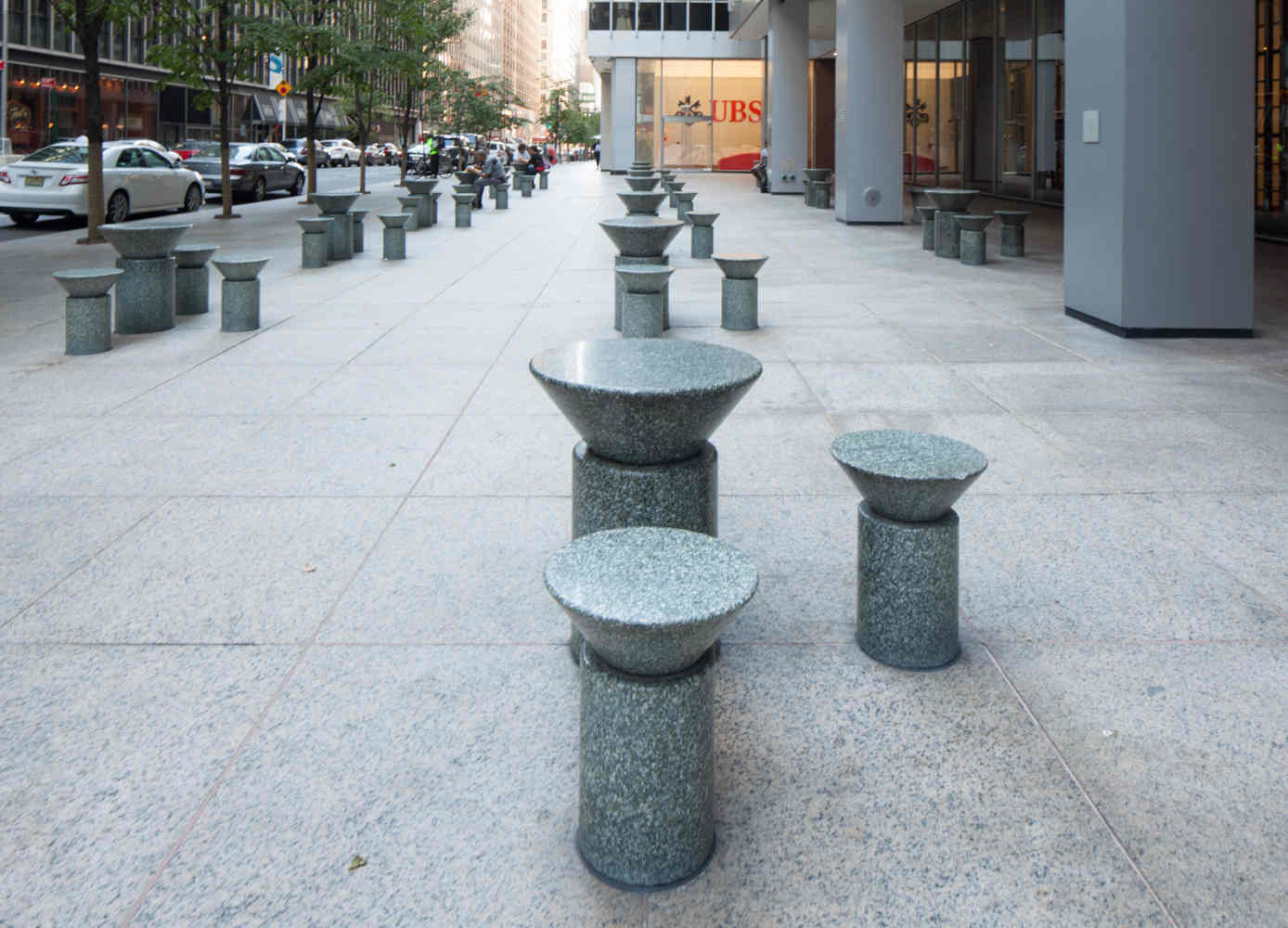
It seems to me that many of these sculpture pieces are in fact below ToO in the US and would be categorized under the law as wholly useful objects without enough creative elements to get copyright protection (he also made a number of furniture pieces that were painted or had decorative elements, which are definitely not below ToO). Again though, I always like to double check with modern/contemporary art, especially when the Artist Rights Society is involved (they claim copyright broadly over all of his works, even his simplest furniture sculptures). Any differing opinions on whether his simple furniture pieces can be uploaded to Commons? Thanks!
(separately, he did not add notices to any of the sculptures I've seen, so obviously there's a whole other path to PD status there, as the majority of his work was made before 1989). 19h00s (talk) 14:56, 6 January 2026 (UTC)
- Hearing no responses, I went ahead and uploaded a few of the simpler Burton works available freely (including some of my own photos). There are several other works I've since found in other photos on Commons, feel free to take a look at the category and decide if any of my assessments are wrong re: these furniture sculptures being below ToO in the US. 19h00s (talk) 03:00, 8 January 2026 (UTC)
- The only thing that jumps out to me are the Buffalo AKG photos. While the object is technically of functional purpose, that has been striped away from it by being put on display in a museum (I concur that the design is generally simple, though). I'm not too familiar with TOO and copyright eligibility regarding 3d objects, so that's outside my wheelhouse.
- All in all, no real points of concern from me. Cawfeecrow (talk) 04:42, 8 January 2026 (UTC)
- The sculpture in Buffalo was the one I was most iffy on as well, but the piece is still used as a functional chair - the other edition was recently on view in St. Louis and they were letting people sit in it. Design-wise though, it's really just two basic shapes put together, with no decoration (any surface texture/color can be attributed to the material). Thanks for taking at look at these! 19h00s (talk) 04:58, 8 January 2026 (UTC)
- Semi-related, does anyone know of any license templates for public domain useful 3D objects like simple furniture? I searched through the various US-PD templates as well as a few of the first images in various furniture categories, but I couldn't find any relevant PD tags. If there's not already something preexisting, I might start drafting language. Thanks! --19h00s (talk) 21:22, 11 January 2026 (UTC)
- The sculpture in Buffalo was the one I was most iffy on as well, but the piece is still used as a functional chair - the other edition was recently on view in St. Louis and they were letting people sit in it. Design-wise though, it's really just two basic shapes put together, with no decoration (any surface texture/color can be attributed to the material). Thanks for taking at look at these! 19h00s (talk) 04:58, 8 January 2026 (UTC)
Publicity stills/film stills, again
[edit]I had some thoughts about the template {{Publicity still}} at Template_talk:Publicity_still#Critical_analysis_of_the_template's_statements. In short, the quoted premises used to justify so-called film stills as free of copyright are problematic: possibly misinformed, and in some cases defective. Comments or arguments are welcome. TheFeds 06:56, 7 January 2026 (UTC)
US Congress 'seal'
[edit]Hello. I feel that File:US Congress seal.png, and accordingly File:Seal of the United States Congress.svg (and potentially other derivatives) may be potentially incorrectly licensed. The source of the original image is now lost, but it is a press release from Edolphus Towns from around 2007. It has been labelled as a “work of the United States Government”, meaning it would've had to been prepared by an officer or employee of the United States Government as part of that person’s official duties. My concern lies in that a member of the House of Representatives, or a member of their staff, may not qualify as an officer or employee of the US government.


There is little guidance on this, which is why I am not sure and why I am raising it here. Typically a member of Congress is not considered an officer of the United States,[1] and I doubt that a member of their staff would be either, unless of course they are employed by Congress. On the contrary, Patry on Copyright includes the following line on the matter:
"In his 1965 report on the general revision effort, Register of Copyrights Abraham Kaminstein explained that “[t]he term ‘employee’ has been supplemented by ‘officer’ to make clear that it includes elected and appointed officials of all branches of the United States Government.”"[2]
This might seem a bit pedantic, but this image is used very heavily across Wikimedia projects, so its licensing status is probably important. Either way, I don't understand a lot about US law so hopefully someone else can help. Thanks. NotADev (talk) 11:22, 7 January 2026 (UTC)
- lol. Yes of course the Seal of Congress is public domain in the US. In addition to who made it, it was also published before 1978 without a copyright notice. See [10] for a history of this (admittedly unofficial) seal. -Nard (Hablemonos) (Let's talk) 16:25, 7 January 2026 (UTC)
- I don't think you understand - the US Congress doesn't have a seal, this is not an official emblem and is not used, nor was it created, by the US Government. The source you cited confirms this. I don't disagree that its likely in the public domain, but I believe that the reason that has been ascribed to it being in the public domain is not correct and should be corrected. NotADev (talk) 17:14, 7 January 2026 (UTC)
- There are congressmen using this seal on their letterheads, adorning their offices, etc. It might not be the official seal of Congress, but it is based on the Great Seal of the US, and adding some words around it doesn't change the copyright status. And the many many congressmen who have used this seal in their offices would disagree with you that they don't work for the government. -Nard (Hablemonos) (Let's talk) 17:20, 7 January 2026 (UTC)
- I never disputed that it isn’t in the public domain, can you please read my post again? NotADev (talk) 18:48, 7 January 2026 (UTC)
- There are congressmen using this seal on their letterheads, adorning their offices, etc. It might not be the official seal of Congress, but it is based on the Great Seal of the US, and adding some words around it doesn't change the copyright status. And the many many congressmen who have used this seal in their offices would disagree with you that they don't work for the government. -Nard (Hablemonos) (Let's talk) 17:20, 7 January 2026 (UTC)
- I don't think you understand - the US Congress doesn't have a seal, this is not an official emblem and is not used, nor was it created, by the US Government. The source you cited confirms this. I don't disagree that its likely in the public domain, but I believe that the reason that has been ascribed to it being in the public domain is not correct and should be corrected. NotADev (talk) 17:14, 7 January 2026 (UTC)
- The Congress as a body does not have an official seal, true -- it's more a graphic logo in the style of a seal, but which is used. The copyright is the same as any other drawing -- if made by the federal government (or published by anyone before 1989 without a copyright notice), it's public domain. That is the only licensing we need. There is an {{Insignia}} template which can indicate some other non-copyright restrictions which may exist (and in this case does -- see 18 USC 713, which has restrictions on the "seal of the United States Congress"). The House and Senate do have official seals, though the graphic typically used for the House is not the actual official seal -- that's a logo in the same style, though still has restrictions. In those restrictions, "use" is more using it to indicate that it's an official congressional statement or work, so you can't use that to mislead someone that a statement or work comes from a different source. Most of the time we are not "using" it in that sense, which is closer to trademark. It's not "use" in the copyright sense, which is more straight copying. I'm not sure which aspect here you are contesting, if it's not the copyright license. It should have the {{Insignia}} tag as a courtesy though, and probably link to that law, the way that File:Great Seal of the United States (obverse).svg does. Carl Lindberg (talk) 01:15, 8 January 2026 (UTC)
- I am not contesting anything, I am just not sure if the seal of the US congress would fall under a work of the US Government if its an unofficial symbol (and that members of Congress may not qualify to be officers or employees of the US government based on the sources I noted). I feel that there's a difference between that symbol and the unofficial one used by the House, as the latter is used much more significantly than the former. It is difficult to find much significant history on the seal of the US congress, which is why I am just not sure, and in any event I don't know much about US law. I never really doubted that it is in the public domain, especially as basically being a copy of the great seal.
- As an aside, 18 USC 713 was a very surreal section to read, and I cannot tell if it is talking about the symbol I am talking about here, or something else (see ). NotADev (talk) 11:22, 8 January 2026 (UTC)
- Congress is part of the federal government, and yes it falls under PD-USGov. That covers all three branches. In particular, laws written by Congress are not to be protected by copyright, so the clear intent is to cover them, whatever the linguistic definition of "officer" is in other areas of the law or constitution. As your link notes, there is no issue if the general term "officer" includes elected positions (they do hold an elected office), while "Officer of the United States" is a particular term with a slightly different meaning. The concept started with the Printing Act of 1895 to include any publication of the government (which would include laws or Congressional stuff). The current wording is more if the copyright would have been owned by the government as a work for hire, excluding works done by employees on their own time. Congressional members should also be employees -- the choice is by election, but they are still paid by the government to perform their lawmaking function. I do believe the seal of congress mentioned in 18 USC 713 is indeed this graphic -- not sure what else that could be. International trademark treaties do not allow governmental seals to be trademarked; thus governments often pass other laws to give them somewhat similar protection at least inside their own country, which is the reason for that clause. The seal mentioned in 4 USC 41 is the Great Seal of the United States -- prior to the Constitution in 1789, the legislative body running the country, under the Articles of Confederation, was called "United States in Congress assembled" (nowadays usually termed Congress of the Confederation). They created the national seal in 1782, and 4 USC 41 was the law which transferred it to the new government. Carl Lindberg (talk) 14:41, 9 January 2026 (UTC)
- The Congress as a body does not have an official seal, true -- it's more a graphic logo in the style of a seal, but which is used. The copyright is the same as any other drawing -- if made by the federal government (or published by anyone before 1989 without a copyright notice), it's public domain. That is the only licensing we need. There is an {{Insignia}} template which can indicate some other non-copyright restrictions which may exist (and in this case does -- see 18 USC 713, which has restrictions on the "seal of the United States Congress"). The House and Senate do have official seals, though the graphic typically used for the House is not the actual official seal -- that's a logo in the same style, though still has restrictions. In those restrictions, "use" is more using it to indicate that it's an official congressional statement or work, so you can't use that to mislead someone that a statement or work comes from a different source. Most of the time we are not "using" it in that sense, which is closer to trademark. It's not "use" in the copyright sense, which is more straight copying. I'm not sure which aspect here you are contesting, if it's not the copyright license. It should have the {{Insignia}} tag as a courtesy though, and probably link to that law, the way that File:Great Seal of the United States (obverse).svg does. Carl Lindberg (talk) 01:15, 8 January 2026 (UTC)
.svg)
References
- ↑ Constitutional Officers: A Very Close Reading. Jotwell. Retrieved on 7 January 2026.
- ↑ 2 Patry on Copyright § 4:70
License check appreciated
[edit]Hi!
I recently uploaded some files from Kremlin.ru. As it can be tricky, what files are free and what not, a check by an experienced user would be appreciated (see: Category:Files from Kremlin.ru uploaded by PantheraLeo1359531). Thank you :) PantheraLeo1359531 😺 (talk) 11:36, 7 January 2026 (UTC)
Question about AI generated images, versus Copyrighted Material.
[edit]A user on a website I admin (which uses MediaWiki as its base) has posed an interesting question to me. I have my own opinion on the matter, which I won't mention here to avoid influencing discussion.
The user has mentioned that many articles on our website, don't have images available for them, because we strictly forbid users to upload copyrighted images, leaving only free ones to use, which aren't always available for the subject concerned.
The user has asked whether it would be permissible to use AI generated images to replace those which we cannot use due to copyright? He argues that they don't pass the threshold for human involvement or intervention in the creation of said images, so they would be public domain.
Where would we stand with the issue of AI generated images being used, where free material isn't accessible or available? Thank you. DaneGeld (talk) 13:57, 7 January 2026 (UTC)
- Hi, Actually, I thought about that when the first AI generated images were uploaded to Commons. So I tried to get a portrait of a French personality for which we don't have a good one. The result was very poor, and not resembling. It remains to be proven that it is possible to get a good portrait of someone for which we do not have a free equivalent, and that this is portrait is not a derivative work of non free content. Yann (talk) 16:16, 7 January 2026 (UTC)
- You can find some information on these questions at Commons:AI-generated media#Can AI-generated media be lawfully hosted on Commons?. Nakonana (talk) 16:27, 7 January 2026 (UTC)
- If there are few or no freely licensed images of a person available, an AI-generated image is likely to either be derivative of non-free images, or an inaccurate representation of the person (or, of course, both).
- One related example that's been brought up in the past is that many image models, when prompted to create an image of an Afghan girl, will reliably produce replicas of the famous 1984 National Geographic photo of en:Sharbat Gula. The use of an AI model to generate an image does not guarantee that the results are not derivative works. Omphalographer (talk) 20:46, 7 January 2026 (UTC)
Copyright status of US Passport Photos
[edit]So I was looking at Category talk:United States passport photos, and while within the category itself, there are many photos which have copyright that have definitively expired, there are 2 sets of photos: Category:Passport photographs of Tupac Shakur and Category:Sam Denby in 2014 which have more ambiguous copyright. The latter of which was uploaded by me and is currently involved in a DR. We need a definitive discussion on the status of the copyright of more recent passport photos, since right now it is unclear and we're not going to stop getting new passport photos any time soon. TansoShoshen (talk) 01:08, 8 January 2026 (UTC)
- @TansoShoshen There's a discussion already open about US passport photos on this noticeboard. Counterfeit Purses (talk) 04:56, 8 January 2026 (UTC)
- I was unaware of that discussion, thank you! TansoShoshen (talk) 05:01, 8 January 2026 (UTC)
File:Salomon Haver certificate Paris 12 Feb 1969.jpg
[edit]I'm don't think File:Salomon Haver certificate Paris 12 Feb 1969.jpg can be kept as currently licensed since it seems very unlikely to be the own work of the uploader, but rather a case of COM:2D copying. So, unless there's a way to keep this per COM:FRANCE (assuming France is the country of first publication), I'm not sure it can be kept at all. My first thought was to tag this with {{dw-nsd}} but decided to ask about it here instead. A notification about this discussion has been added to the uploader's user talk page; so, perhaps they can clarify more about the file's provenance. -- Marchjuly (talk) 01:27, 8 January 2026 (UTC)


reply to copyright issue
[edit]To clarify the provenance and copyright status of the file.
The scan itself is my own work, created by me as part of my academic and historical research. I personally scanned the original physical document; it was not copied from another publication, archive, or online source.
Regarding copyright: the underlying document is a certificate of honor bestowed by a rabbi, issued in 1969. It is a formal, factual certificate, containing no creative or literary authorship beyond standard formulaic wording. Such documents are generally considered non-copyrightable due to lack of originality (cf. COM:TOO and COM:PD-text principles), or alternatively as an official/ceremonial document not intended as a protected creative work.
There is no indication of a rights holder asserting copyright over this certificate, and no restriction was attached to the original document. To the best of my knowledge, it does not carry copyright protection, and therefore the scan does not constitute COM:2D copying.
If France is considered the country of first publication, I believe the file can be retained under Commons policy, either as public-domain text or as a lawful reproduction of a non-copyrightable document. Drkup(IMJ) (talk) 05:48, 8 January 2026 (UTC)
File:Orbitzsoda.jpg
[edit]This file, which was uploaded 15 years ago, appears to be a scan from a magazine or some other print publication (edges on top edge, bottom right corner). It also appears to be laid out like an official ad, which if true means it's probably not good for Commons. I've done some digging and I haven't found this exact image, but I suspect it may be from a 1996 issue of Packaging World magazine - this article is dated July 1996 and appears to have an extremely bitcrushed, cropped version of the same image. I have been unable to find any archives of the magazine going back to the 90s, however. Another one of the uploader's files was apparently deleted for missing permission information, so it's possible this one may be mistakenly attributed. If I had a smoking gun I'd be more willing to start a deletion request, but as-is I'm basically just going off of vibes and I'm not quite sure what to do. Jan-Janko (talk) 05:36, 8 January 2026 (UTC)


- I'd go ahead and nominate that for deletion. Even if we haven't identified the precise source, the image looks very much like a print advertisement - "own work" seems unlikely. Omphalographer (talk) 07:09, 8 January 2026 (UTC)
Category:Works copyrighted in the U.S.
[edit]Category:Works copyrighted in the U.S. contains thousands of files using Template:Not-PD-US-URAA. This template is intended to be used solely for files uploaded before 1 March 2012, but the majority of files in the category were uploaded after that date.
Can a bot be created to tag these files for deletion like with files that have missing permissions? Manually seeing which files are uploaded after 1 March 2012 is an excessive amount of work for a person. Traumnovelle (talk) 21:33, 8 January 2026 (UTC)
- To clarify, It's the files uploaded after 1 March 2012 one would tag for deletion, right? During the time a bot doesn't exist, I'll do what I can manually. As you've mentioned It's a lot of work for a person, but I do have a decent bit of free time. Cawfeecrow (talk) 03:43, 10 January 2026 (UTC)
- *that have missing permission info/with provided info, would not be PD in the US, of course. Cawfeecrow (talk) 03:47, 10 January 2026 (UTC)
- Yes, the bot would be for tagging files after 1 March 2012 for deletion similar to how files with no permissions are tagged. Traumnovelle (talk) 04:19, 10 January 2026 (UTC)
Copyright on Tanzania National Bureau of Statistics map data
[edit]I would like to use these Shapefiles (map data) from the Tanzania National Bureau of Statistics (NBS). I found this licence which seems compatible with Commons. Commons:Copyright_rules_by_territory/Tanzania says "mere data" is not protected. I am not sure how US laws would apply. Commons:Copyright_tags/Country-specific_tags doesn't have a Tanzania section. This is about a Zanzibar (section of Tanzania) map request on enwiki, if that makes a difference. Commander Keane (talk) 13:37, 9 January 2026 (UTC)
Two questions about COM:CUR Thailand
[edit]Hello.
I am currently considering nominating an image of a piece of Thailand currency per COM:CUR Thailand. However, I have two questions that the policy sentence does not answer, and the (now broken)cited link cannot answer:
1. Does the definition of "banknote" include Thai military payment certificates apparently issued by the Thai Military Bank?
2. Does Thailand's disallowance of reproductions of banknote images apply to banknotes not in circulation anymore?
Thank you for reading. Cawfeecrow (talk) 05:38, 10 January 2026 (UTC)
Avast secureline vpn logo and promotional image
[edit]I am looking to update the logo and image on the article about avast secureline vpn [11] with the logo in the corner and first image you see when you scroll down on the official website. The problem is that these are likely copywrited, however there is already a logo and screenshot on the page currently, just not an up to date one. What do I do? Duplicake (talk) 00:41, 11 January 2026 (UTC)
- @TheTechyOne It's likely that the SecureLine logo is below COM:TOO US as it's a simple shape - the {{PD-simple}} tag exists for this and it can be uploaded here. HurricaneZeta (talk) 02:19, 11 January 2026 (UTC)
A legal comment on the italian copyright extension for simple photographs
[edit]Hi everyone. Following this discussion on the recent change in Italian law, I've found this legal comment on the issues that remain open.
I'll translate the most relevant parts: The new duration will apply only to future photographs or also for those already existing? The answer, according to the interpretation now largely prevailing in the Italian jurisprudence, is that the change will be applied to all simple photographs whose copyright was still existing at the time of the entry into force of the reform. Technically speaking, this is not a retroactivity, but a change on legal situations which are still in progress.
This means in practical terms that all the simple photographs taken from 2005 onwards will remain copyrighted until 70 years after their production.
The second question is: Will the photographs which were already in PD be copyrighted again? The jurisprudence on this point is much more clear-cut: a photograph that had already fallen in PD on 18th December 2025 will remain free. The law doesn't envisage a "resurrection" of expired rights and such an interpretation would be scarcely compatible with the principles of legal certainty and legitimate expectations.
I'd suggest for now to update the relevant templates (Template:PD-Italy) and pages (Commons:Copyright rules by territory/Italy) to the new terms using this interpretation (that wouldn't change anything in practice, since we already don't accept post-1976 PD-Italy photos per the US law). If and when something new will turn up, we will always be able to revise this decision...
I'm pinging the users who took part to the previous discussion @Rosenzweig@JWilz12345@Yann@Clindberg@Teetrition@Arrow303. Friniate (talk) 14:54, 11 January 2026 (UTC)
- Thanks, that was always the most likely case to me. So existing copyrights get extended, but works that were PD remain PD. Carl Lindberg (talk) 15:03, 11 January 2026 (UTC)
- Thanks, that's a useful information. Yann (talk) 16:50, 11 January 2026 (UTC)
Permission granted to upload to Wiki, what CC does that translate to?
[edit]Hi all, I found a batch of useful photos on Facebook and asked the poster this:
"I'd like to use some of the photos you uploaded to the "Light Railways of Australia" page in some Wikipedia articles, e.g. the photo of 1NH here - https://www.facebook.com/photo/?fbid=6763304007065621&set=pcb.6526389510751410 - would be excellent for this article - https://en.wikipedia.org/wiki/Victorian_Railways_narrow-gauge_freight_vehicles Do I have your permission to do this?"
They responded,
yes any photographs from me are fine. My grandfather P G Dow took the originals. Regards Robert
What Creative Commons license is that closest to? Anothersignalman (talk) 19:05, 11 January 2026 (UTC)
- @Anothersignalman: None. You can use the page Commons:Permission requests to ask help with requesting a free license. -- Asclepias (talk) 19:40, 11 January 2026 (UTC)
- @Anothersignalman Only possibility might be a local upload to English Wikipedia under a fair use rationale because you got permission to use it for the English Wiki article in question, see WP:FAIRUSE. Nakonana (talk) 23:54, 11 January 2026 (UTC)
- And/or you can read COM:THIRD where you will find something very similar to what you wrote in the section COM:THIRD#What not to do. Jmabel ! talk 00:05, 12 January 2026 (UTC)
- Thanks all, I've reached out to the copyright holder. Anothersignalman (talk) 06:38, 12 January 2026 (UTC)
- The copyright holder has looked at the options and seems willing to proceed, but they are not able to manage the upload process. Can I upload the photos, with captions etc, on their behalf but with only the tag "{{subst:OP}}" as a placeholder, pending an email between them and the VRT? After that, the VRT can choose whether to keep or delete the files, and if they keep them, then I can use them in various articles?
- Alternatively, if the copyright holder explicitly says to me in, say, Facebook messenger that they give permission to upload under {{CC-BY-SA 4.0}}, is that sufficient for me to manage it? Or would I also need to provide a screenshot of the discussion to the VRT, and/or the person's contact details if they wish to independently confirm same? Anothersignalman (talk) 20:19, 12 January 2026 (UTC)
- @Anothersignalman: Do you know which license the copyright holder agrees to? Yann (talk) 20:32, 12 January 2026 (UTC)
- (supplementing Yann's remark:) …because without a license specified, it will probably be deleted 7 days from when a bot notices that no license is specified. - Jmabel ! talk 20:50, 12 January 2026 (UTC)
- I have asked them for explicit confirmation of CC-BY-SA 4.0, maybe an hour ago. They have not said yes yet, I probably won't have an answer till this afternoon or tomorrow morning. Anothersignalman (talk) 20:54, 12 January 2026 (UTC)
- Thanks all, I've reached out to the copyright holder. Anothersignalman (talk) 06:38, 12 January 2026 (UTC)
Can this 1957 photo be uploaded to Commons?
[edit]I would appreciate guidance on the copyright status of this photograph, taken in 1957 by Canadian professional photographer Joe Stone Sr. (d. 1988), of the “Stone and Son” studio (to distinguish him from his son, Joe Stone Jr., who worked later, was also hired by UNB, and died much later). The photograph was commissioned and published by the University of New Brunswick. The page currently displays a “© UNB” notice, which is why I am seeking clarification. Tinterest (talk) 01:35, 12 January 2026 (UTC)
- Probably still under copyright. If the photographer died in 1988, it would be under Canadian copyright until 2059. US copyright would expire in 2053 though so enwiki would be able to host it sooner than us. Abzeronow (talk) 01:41, 12 January 2026 (UTC)
- Thank you for the clarification. Tinterest (talk) 01:46, 12 January 2026 (UTC)
- Canadian copyright law for corporations used to be different. If it was commissioned and the rights were held by the University back when it was created/published in 1957, it might be Public Domain in Canada... BUT it is not PD in the USA, so you still cannot upload it here yet. See here; En-Wiki PD-Canada No. 3 PascalHD (talk) 22:10, 12 January 2026 (UTC)
Smithsonian image
[edit]I'd welcome some advice on this image, from the Smithsonian. As far as I know, the Smithsonian isn't technically part of the US Federal Government, though it's operated by it, which makes it murky as to whether its employees count as federal employees for the purposes of {{PD-USGov}} etc. This one was taken in 1972 by Alfred Harrell (on whom I can find nothing) -- the page says that it is not in copyright in the United States. Any ideas if it's likely to be fair game, and if so under what licence? UndercoverClassicist (talk) 22:41, 12 January 2026 (UTC)
- Works created by direct SI employees are indeed in the public domain. The tricky part usually is figuring out if the employee who created the work in question was a direct SI employee or employed by the Smithsonian Trust, which is an administrative entity separate from the federal government. Works by SI Trust employees are not automatically in the public domain. Here, the photo was created by Alfred Harrell, an employee of the now-defunct Smithsonian Institution Photographic Services Division. From what I can tell, that office employed staff members as direct Smithsonian employees - all of the photos originating from that office in the SI online archives (or, the photos that aren't of copyrighted subjects) are marked "no copyright". So I think you're safe to upload it and add Template:PD-USGov-SI. 19h00s (talk) 04:06, 13 January 2026 (UTC)
- Thanks. I've done that and linked this conversation. UndercoverClassicist (talk) 07:26, 13 January 2026 (UTC)
How to see if a YouTube short is CCBY?
[edit]When filtering the YouTube search for creative commons videos, sometimes some these 'short' videos show up. However, unlike with normal videos I can't see any info on the license in the video description (visible when clicking on the video title).
How can one check whether it's CCBY? This is not just in regards to the uploader but also for license reviewers and generally people other than the uploader who originally found it in the YouTube search results. Examples: [12] [13]. Prototyperspective (talk) 00:00, 13 January 2026 (UTC)
- If you're on desktop, you have to use a different url path. Switch from "youtube.com/shorts/..." to "youtube.com/watch?v=...", where the "..." is the unique video code in the original URL. Then you'll switch from "Shorts mode" to standard mode where you can see full video information, including the license if it's CC. Examples: [14] [15] --19h00s (talk) 00:14, 13 January 2026 (UTC)
- Thank you! Probably this info should be somewhere – maybe Commons:YouTube files/Downloading or is there a better place for this info? Prototyperspective (talk) 00:47, 13 January 2026 (UTC)
Mozambican copyright law needs updated + copyright question
[edit]The current template for {{PD-Mozambique}} cites the 2001 copyright law which was revoked in 2022 and replaced with a different copyright law (English translation version for convenience). Could someone update that?
Also there's an image on the Administrative Tribunal of Mozambique's website that I wanted to upload (the bottom-most one). Is that allowed since it's from a major government entity? Thanks! Urchincrawler (talk) 03:37, 13 January 2026 (UTC)
- COM:MOZAMBIQUE seems to only have "Official texts of a legislative, administrative or judicial nature, or official translations thereof" for public domain government works and photos are not texts. Abzeronow (talk) 03:45, 13 January 2026 (UTC)
- Ok. I just wasn't sure if that was still the caee since it seens (at least on the template page) it hasn't been updated for the 2022 version of their copyright law. Urchincrawler (talk) 18:09, 13 January 2026 (UTC)
The Gay Sisters
[edit]en:File:The Gay Sisters.jpg is a circa 1950 US publicity photograph of unknown origin. What are the chances it is PD, and how can that be determined?. Andy Mabbett (Pigsonthewing); Talk to Andy; Andy's edits 13:42, 13 January 2026 (UTC)

- Based on previous experience, there's a strong likelihood that it's PD. Determining it, however, would mean finding a digitization that has both the front and the back to show no copyright notice. I just skimmed Ebay quickly, and I was unable to find any images of them - just a few records, which probably are PD-Simple. — Chris Woodrich (talk) 15:11, 13 January 2026 (UTC)
Publication of paintings
[edit]Hi, When should a painting be considered published? This concerns among other files these paintings. When and where does a painting like this get published? It was owned by Jane Frances Klee (1908-1999), who married Alfred Joseph Friedlander, and then later married Donald Samuel Steinfirst ([16]). As part of her bequest, it came to the Cincinnati Art Museum. See also [17]. Apparently, it was sold directly by the painter to someone living in USA. Yann (talk) 21:20, 13 January 2026 (UTC)
